
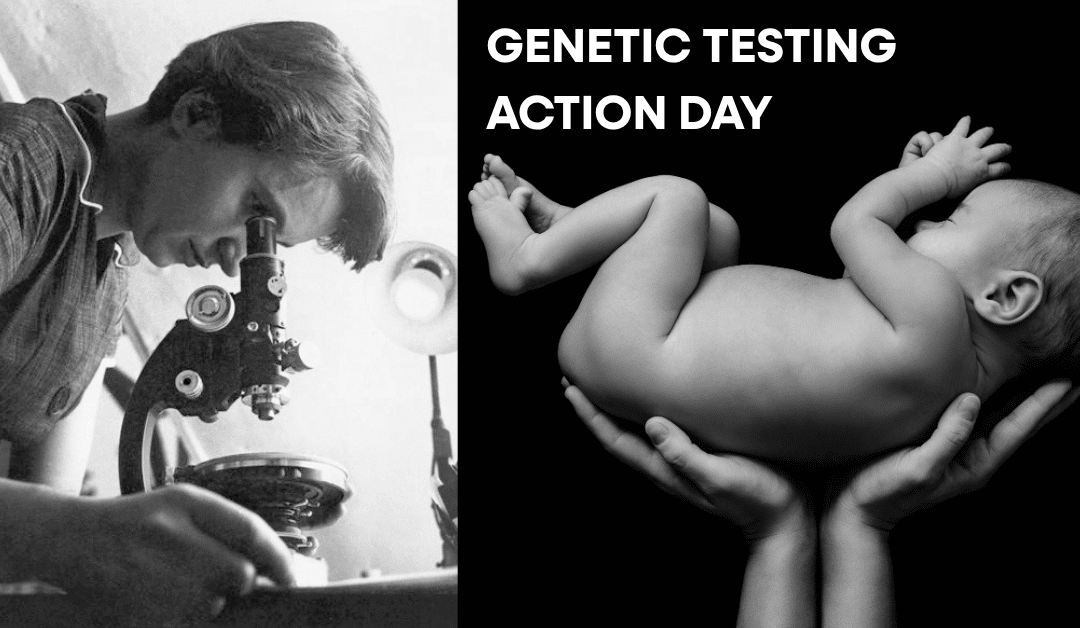
Every July 25th, the genetic health community comes together to recognize Genetic Testing Action Day, and this year marks only its second annual celebration! The observance was created in 2025 by Start Genetic, a public awareness initiative dedicated to increasing awareness and access to genetic testing, and it is observed on July 25th specifically to honor the birthday of Dr. Rosalind Franklin. Born in 1920, Dr. Franklin was a scientist at King’s College London whose groundbreaking X-ray crystallography work in 1952 was foundational to the discovery of DNA’s double helix structure. Her contributions to our understanding of genetics were monumental, and this date was chosen as a way to recognize the science she helped build and the millions of lives that science has the power to protect.
Since its launch in 2025, Genetic Testing Action Day has grown into an international initiative supported by patient advocacy organizations, healthcare providers, researchers, and rare disease communities around the world. Its mission is straightforward: too many families face years of uncertainty before receiving an accurate genetic diagnosis, and it does not have to be that way.
For the G6PD Deficiency Foundation, that message is personal. G6PD deficiency screening is not just a medical checkbox. It is information that can protect a newborn from preventable brain damage, help a pregnant mother make safer choices during her pregnancy, and give an individual who has spent years feeling unwell a real answer at last. For a condition as common as G6PD deficiency, one that affects an estimated 400 million people worldwide and up to 6 percent of newborns in the United States, the absence of routine G6PD deficiency screening in most states is a gap that costs families dearly.
We’re going over why testing matters, what G6PD deficiency screening actually looks like, and what you can do to make sure your family has the information it deserves.
What Is G6PD Deficiency and Why Does Screening Matter
G6PD deficiency is the most common human enzyme disorder in the world. The enzyme, glucose-6-phosphate dehydrogenase, protects red blood cells from oxidative stress. When the body does not produce enough of it, red blood cells are more vulnerable to breaking down, a process called hemolysis, when exposed to certain triggers. Those triggers include specific foods, medications, illness, and environmental exposures.
The majority of people with G6PD deficiency have no obvious symptoms in the absence of those triggers and are often completely unaware they carry the condition. This is precisely what makes G6PD deficiency screening so important. Without it, families have no way of knowing what they are dealing with until something goes wrong.
And when something goes wrong in a newborn, it can go wrong very fast.
G6PD deficiency has the potential to cause attacks of acute hemolytic anemia, severe neonatal jaundice that can lead to a serious form of brain damage called kernicterus, and in rarer cases, chronic anemia. In Brody’s case, the foundation’s namesake, undiagnosed G6PD deficiency combined with mismanaged newborn jaundice led to kernicterus at just one week old. That brain damage was preventable. The only thing missing was a G6PD deficiency screening at birth.
That is the case for G6PD deficiency screening in a single story. And it is a story that has played out in far too many families who never should have had to experience it.
What G6PD Deficiency Screening Actually Looks Like
For newborns, G6PD deficiency screening is a blood test, specifically a small blood draw typically from the baby’s heel, that measures the level of G6PD enzyme activity in the red blood cells. It is fast, straightforward, and can be included as part of routine newborn screening panels. In New York State, it now is.
On December 23, 2021, New York State Governor Kathy Hochul signed the Brody James Bill into law, making New York the first state in the nation to add G6PD deficiency to routine newborn screenings. The bill, introduced by State Senator Gustavo Rivera and Assemblyman Richard Gotfried, was named for two individuals whose lives were permanently altered because G6PD deficiency was not diagnosed until after it had already caused irreversible harm. It was a historic moment, and it was the direct result of years of advocacy by us here at the G6PD Deficiency Foundation and everyone who has supported us all this time.
But New York is one state. There are 49 more to go.
For adults and older children, G6PD deficiency screening involves a quantitative blood test that measures enzyme activity levels. Cases of G6PD deficiency are classified based on the measured level of enzyme activity and associated clinical signs. A result that shows low G6PD activity is not a diagnosis of illness. It is information, and information is the starting point for everything that comes next.
The Prenatal Angle: Where Screening Should Begin
One of the most underutilized opportunities in G6PD deficiency screening happens before a baby is even born.
We strongly suggest that prenatal mothers be tested early for G6PD deficiency as part of their prenatal screening process. Testing the mother during pregnancy will indicate whether she is a carrier for G6PD deficiency and help determine how to keep her healthy throughout her pregnancy. The results can also directly shape the protocol for newborn screening after delivery.
Because G6PD deficiency is X-linked, meaning it is carried on the X chromosome, a mother who carries the gene has a significant chance of passing it to her children. A male child who inherits the affected X chromosome from his mother will have G6PD deficiency. A female child who inherits it may be a carrier, and depending on X-inactivation, may express symptoms as well. Knowing a mother’s carrier status before delivery gives healthcare providers critical context for how closely to monitor a newborn for jaundice, what triggers to avoid in the immediate postpartum period, and whether additional testing for the baby is warranted right away.
This is exactly the kind of information that could have changed the outcome for Brody and his family. And it is the kind of information that obstetricians and midwives can act on today, if they think to ask.
If you are pregnant or planning a pregnancy and there is any family history of G6PD deficiency, severe newborn jaundice, or unexplained hemolytic anemia, bring it up with your OB at your next appointment. Ask specifically whether G6PD deficiency screening can be added to your prenatal panel. It is a simple blood test, and the information it provides is life changing.
Why So Many People Are Never Screened
The gap in G6PD deficiency screening in the United States is not the result of the condition being rare or the test being difficult. It is largely a result of awareness, or more accurately, the lack of it.
G6PD deficiency was first identified in 1956. It is the most common inherited enzyme deficiency in the world. And yet most medical students receive only a few minutes of education on it, if it is covered at all. Many healthcare providers are unaware of how common it is, how significant its impact can be in the newborn period, or that a simple, reliable test exists to identify it.
This is why G6PD deficiency screening continues to be inconsistently offered across the United States. Newborn screening panels vary by state, and while New York has led the way, most states have yet to add G6PD deficiency to their routine panels. Our foundation is actively working to change that, with Massachusetts up next, and continuing state by state until every newborn in the country is screened.
In the meantime, families should not have to wait for their state to catch up. Asking your provider about G6PD deficiency screening, whether for a newborn, a pregnant mother, or an adult who has never been tested, is something you can do right now.
What Screening Can Do for Adults Who Have Never Been Tested
G6PD deficiency does not only affect newborns. Adults who carry the condition and have never been diagnosed may experience recurring fatigue, anemia, or unexpected reactions to medications without ever understanding the cause. Because the majority of people with G6PD deficiency have no obvious symptoms in the absence of triggers, many go through life without ever connecting their experiences to an underlying genetic condition.
For women especially, the picture is complicated by the fact that female carriers have historically been told they do not need to worry about their G6PD status because they carry the gene on only one X chromosome. But due to a process called X-inactivation, some women express G6PD deficiency just as severely as men and are routinely misdiagnosed or dismissed.
A G6PD deficiency screening result gives adults the information they need to make informed choices about medication, diet, and lifestyle. It turns years of unexplained symptoms into something actionable. It gives people the ability to walk into a medical appointment and say, with certainty, here is what my body needs.
Genetic Testing Action Day and What It Means for G6PD
Genetic Testing Action Day was created precisely because awareness of genetic testing options is still far from universal. Start Genetic, the initiative behind the awareness day, was founded by parents navigating rare genetic conditions for their own children. The campaign was born out of a simple but powerful truth: too many families spend years searching for answers that a test could have provided far sooner. Since its inaugural year in 2025, dozens of patient advocacy organizations and rare disease communities have joined in support, making it one of the fastest growing genetic health awareness movements in recent memory.
G6PD deficiency is a perfect example of a condition where that gap in awareness has real and sometimes devastating consequences. The test exists. The condition is the most common inherited enzyme deficiency in the world. And yet most families have never been told to ask for it.
We want every family to walk out of their next medical appointment knowing whether G6PD deficiency screening is right for them. Not because it is scary, but because it is straightforward, because the test is simple, and because the information it provides can shape every medical decision that follows.
G6PD deficiency screening during pregnancy. G6PD deficiency screening for newborns at birth. G6PD deficiency screening for adults who have never been tested. Each of these is an opportunity to catch something early, to give a family the information they deserve, and to prevent an outcome that should never have to happen.
One healthy state down. Forty-nine more to go.
What You Can Do Today
If you have never been tested for G6PD deficiency, or if you are pregnant and have not discussed G6PD carrier status with your provider, Genetic Testing Action Day is a meaningful moment to take that step. Bring it up at your next appointment. Ask about testing. Share this post with someone who might need to see it.
And if you want to support the work of getting G6PD deficiency screening to every state in the country, we would love to have you alongside us.
Have questions or want to learn more? Reach out to us directly through our Contact Page. Follow us on Facebook for the latest updates, educational content, and community support
Recent Comments